JONAH RASKIN / BOOK REVIEW / Levitating the Pentagon


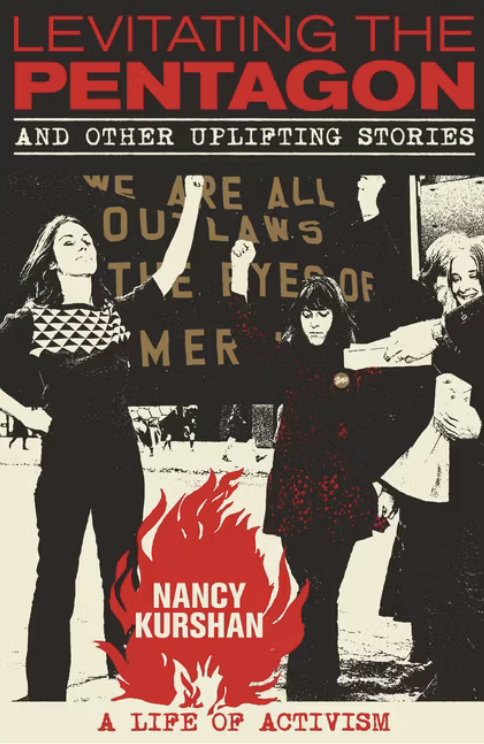
Levitating the Pentagon, and Other Uplifting Stories
: A Life of Activism By Nancy Kurshan; Three Rooms Press; 2025

By Jonah Raskin / The Rag Blog / December 29, 2025

Nancy Kurshan might have carved out and published a big chunk of her own story soon after the dramatic protests at the Pentagon in 1967, and in the wake of the 1969-1970 Chicago Conspiracy Trial. If she had done that, her book would have appeared in print at about the same time that those two Yippie classics became best sellers: Jerry Rubin’s Do It! and We Are Everywhere and Abbie Hoffman’s Revolution for the Hell of it and Woodstock Nation

Kurshan wisely waited decades to provide her account of the rambunctious Sixties and Seventies, a time when she was in the thick of the anti-war movement and a driving force in righteous causes against racism and injustice that afflicted Black, brown and Native American communities. She seemed to know intuitively which way political and cultural winds were blowing, how to ride ideological storms and keep her wits about her. 

The first hundred or so pages of her memoir, Levitating the Pentagon and other Uplifting Stories — which has just been published by Three Rooms Press — describe her membership in Yippie, her relationships with Jerry Rubin, Abbie Hoffman, and their ilk, along with her exhilarating moments in Hanoi, Moscow, and Havana. Plus her birth in 1944 to parents who belonged to the American Communist Party and who helped to shape her world view from an early age. 

Three Rooms Press also published Judy Gumbo’s memoir Yippie Girl. The two books, Gumbo’s and Kurshan’s, compliment one another.

Kurshan’s memoir might have stopped at the end of the 1970s. After all, as she writes near the end of her story, “Born a Red Diaper Baby who morphed into a Yippie, and joined the Weather Underground, I love the life I’ve lived.” She wisely doesn‘t stop with her membership in the Weather Underground and its offshoot — The Prairie Fire Organizing Committee. With passion and clarity, Kurshan explores her participation in the 1990s in the movements that aided political prisoners and decried the inhumane conditions that existed behind bars. She also recounts her personal life: her romantic relationships with other radicals; marriage to fellow activist, Steve Whitman, their family life together and her children. Howie Emer, with whom she had a long, trusting relationship — and a largely unsung, longtime radical — is the father of her children.

In an interview with author Pat Thomas, who has written about Jerry Rubin, the Black Panthers, and Allen Ginsberg, Kurshan says, “I don’t think I was a natural Yippie.” (That interview with Thomas appears near the end of her memoir.) Granted, she didn’t appear before the House Committee on UnAmerican Activities (HUAC) as dramatically and as effectively as Abbie and Jerry did when they were in costume. Abbie in a shirt made from an American flag. Jerry dressed as an American patriot circa 1776 and later as a member of the Viet Cong and later still as Santa Claus. 

Continue reading
Posted in Rag Bloggers, RagBlog | Tagged , , , , , , , , , , , , , , | Leave a comment

DANIEL ACOSTA, JR. / HIGHER EDUCATION / Ideological Warfare at the University of Texas

Daniel Acosta, Jr.

Make UT Great Again (MUGA)

By Daniel Acosta, Jr. / The Rag Blog / December 10, 2025

The University of Texas is facing an existential crisis because of its decision to appease the Texas governor and legislature by providing a more ideologically diverse curriculum to UT’s current programs. According to UT’s Provost, “our university leadership is having constructive behind-the-scenes discussions with the White House on the Trump Compact.” He further says that UT “aligns with the principles of conduct that they (the White House) want” (see the October 28th Chronicle of Higher Education interview of Provost William Inboden).

Certain UT colleges have been targeted for restructuring to bring their curricula more in line with what the President and Provost want the colleges to offer the students (i.e., a more optimally structured academic mission). The Provost states that “we will in time be announcing reforms and restructurings in the College of Liberal Arts, the College of Natural Sciences and others.” His plea to everyone on campus is: “Wait until we have something announced, and then we have that discussion.”

And so it goes. Cryptic messages to the public and the faculty on how UT will become great again with limited debate with those people most involved in higher education on campus — the faculty and students. Of course, an ideologically diverse curriculum is not the same as promoting a faculty and student body that are culturally and racially diverse. That is not allowed in the great state of Texas.

I returned to Austin in 2019 to spend my retirement years with my family. Although UT has had three different presidents in the last six years, UT still remains one of the best public universities (see the 2026 U.S. News & World Report). so why do the UT president and provost proclaim that our great state university “has lost its way” and needs to regain the public’s trust? Is “Make UT Great Again” the new slogan for this new UT administration, instead of the current one — “What Starts Here Changes The World?

Fifty years ago I was the second Mexican-American PhD professor on the pharmacy faculty since the founding of the College in 1893. Today there is only one Chicano professor. The number of Black and Hispanic tenured faculty at UT is embarrassingly low, compared to the other top 10 public universities.

The Presidential leadership team of VPs and deputies consists of seven white men and six white women. Out of the 15 active deans of colleges (plus three interim deans who are not included) there are seven white men, four white women, two Hispanic men, one Hispanic woman, and one Asian woman. Diversity has never played a role in the leadership of the University of Texas for over 170 years. So why is everyone now complaining that DEI had lowered the quality of education and research at UT?

I left UT after 20 years as a tenured professor and director of the toxicology training program because I was told I wasn’t suited for a higher administration position. I finished my career as the dean of pharmacy at the University of Cincinnati Medical Center and later as the Deputy Director for FDA’s major research center — The National Center for Toxicological Research.

My wife and I helped fund a graduate student endowment in pharmacology and toxicology at the College of Pharmacy to assist students attend scientific conferences. I reached out to the new dean of pharmacy to establish an endowment to attract more Hispanic faculty to the college. But my efforts to improve the diversity of faculty and students at the college have been blunted by state regulations which hamper attempts to add more diverse and well-qualified individuals to the faculty.

[Acosta is retired and lives in Austin. He’s Dean Emeritus of Pharmacy at the University of Cincinnati Medical Center and former Deputy Director of FDA’s National Center for Toxicological Research.]

Posted in Rag Bloggers, RagBlog | Tagged , , , , , , , | 1 Comment

LARRY PILTZ / VERSE / Save The Futures

Save The Futures

By Larry Piltz / The Rag Blog / December 11, 2025

To save our futures
we’ll need supplies of sutures
to stitch tightly up with courage
the scourges
violent urges
to bind the wounds and spare the dirges
caused by those who sow reckless harm
they’ve chosen their dharma karma and smarm
We’ve been intentionally riven
by people driven
to bring suffering
we’ll need lots of wound closure
lots of buffering
and infinitely less exposure
to those cruel inhumane
and savage false savants
and their callous affronts
those bloody dilettantes
who are truly the insane
Tyrannical persecutors lust
with the imagination of rust
fascists prizing precious hates above all else
these false idols and false gods
those proud zealous clods
obsessed with their fearful inadequate selves
to them it’s oppression or bust
They are the retread undead
grievances are what they’re gladly fed
and it’s our bodies they’d snatch
if they could would kill our souls
these unmitigated assholes
those sons of hitlerites
these daughters of spite
these generations of vipers
fascinated by obvious lies
dazzled by windshield wipers
and painfully frazzled by truth
it doesn’t take a sleuth
to think them down to size
look them in the eyes
and try not to laugh
at those whose dumb wrath
seek a bloodbath
If only it were only graft
and venal corruption
and not a fully unhinged
fascist disruption
to drag our nation
from its fragile stable station
down to their level of infantilization
with its primitive rage
in permanent end-stage
all or nothing demented rampage
and who act the sage
reciting warped tragic history
while pretending innocence intrigue and mystery
these schemers nightmare dreamers
harebrained screamers
with apologies to hares
the comparison’s unfair
Hares wouldn’t claim victimization
and brag about a sadistic vindication
while reducing civilization
to its violent bare essential
the brutal quintessential
their illness chronic and acutely mental
they who deny political asylum
to those tortured and hounded
their bodies minds pounded
by those in their fellow fascist phylum
these ogres of the species
their minds full of feces
they consider inspiration
as the corpses high they pile them
Why their desperation
for total desensitization
are they jealous of a nation
who can feel emotion sensation
that doesn’t promote annihilation
and can compete on a fair playing field
of honesty, intelligence, and kindness
without sword and shield
do they know they can’t be healed
by their sociopathic blindness
about only themselves can they care
while they brazenly malign us
Among leaves of grass they are weeds
dispensing poison’s seeds
their life a coward’s dare
their threat an existential bet
now we must do our share
their brutal quintessential not quite here yet
be wild and free like the hare
with its survivor’s clever stare
and accept their coward’s dare
Larry Piltz

Posted in Rag Bloggers, RagBlog | Tagged , , , | 1 Comment

MARTIN J. MURRAY / REMEMBRANCE / Larry Caroline disarmed critics without demeaning them

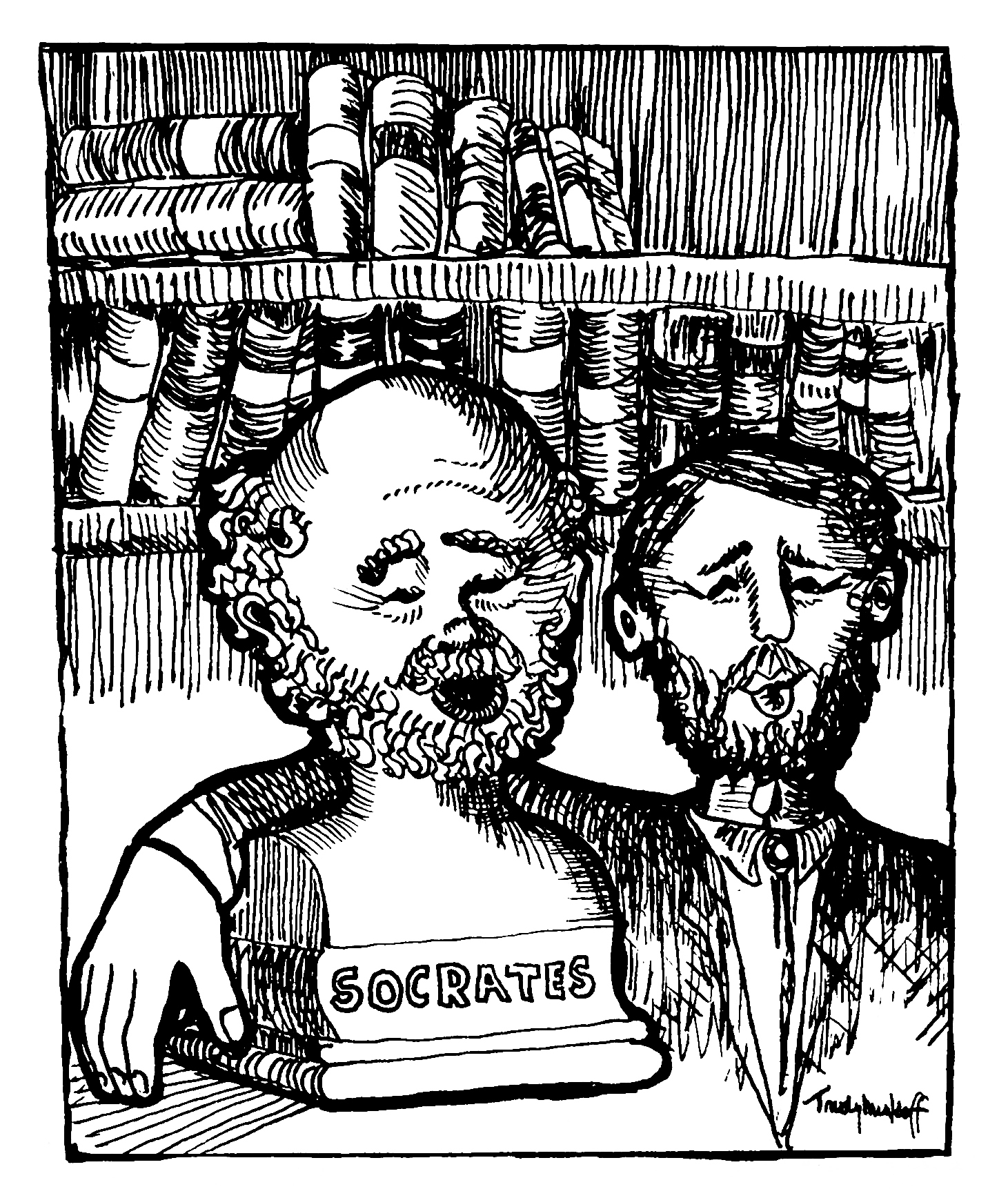
Larry Caroline and Friend. Art by Trudy Minkoff, The Rag, May 11, 1968.

By Martin J. Murray / The Rag Blog / December 4, 2025

I knew Larry Caroline for only a few short years in Austin. It was a memorable experience. My first recollection of Larry was at the Capitol Building around October 10, 1967. This tall, lanky guy with a big beard got up to speak. He put into words what I knew but could not articulate clearly. The guy — Larry — went through a long list of “wrongs” in America, persistent racial injustice, continued segregation in the South, corporate greed, political indifference.  He said “you can’t change things one at a time. The whole bloody mess (using a British phrase) has to go. Then more.

Wow. He put into words what I was thinking but was unable to articulate.

Soon after, I started going to SDS meetings. I saw Larry in action. He could formulate an argument so quickly. What I remember in watching him in dialogue with young people who did not share his views that he was never demeaning, dismissive, or arrogant. He showed with rational rigor the “wrongness” of their ideas defending capitalism and the war.  I have never forgotten his style of debate and have tried to emulate it ever since. Disarm your critics but never demean them as persons.

Larry was part of the “big three”: slightly older men whom I admired. Martin Wiginton was the ultimate tactician — focusing on what to do in building demonstrations. Greg Calvert was the strategist, thinking beyond the antiwar movement about how to build coalitions to challenge capitalism and its war fever. Larry was the great thinker, using rational thought and logic to work through big problems.

In Larry’s last term in the Philosophy Department (I believe Spring term 1969), I was his teaching assistant.  What a joy. I got to hear his lectures the whole semester. He was so smart

Frank Erwin was, of course, the Grand Inquisitor. But John Silber was his handyman.  Greg Calvert once likened Silber to the famous quote about Talleyrand –“he’s nothing but shit in silk stockings.”

Larry was done such a great disservice by Erwin, Silber, and the leadership of the Philosophy department.  Through it all, Larry maintained a high public profile.

In the time I spent with Larry before he started working at the alternative school Greenbriar, I learned how to think. I read his dissertation chapter named “Why be Moral?” It was so informed and erudite.

His legacy for me is straightforward: he got me to think and to be kind to others, even when we disagree with them.


Martin J. Murray is the author of Insurgent Politics in the Lone Star State: Remembering the Antiwar Movement in Austin, Texas, 1967-1973.


Rag Blog Afterword

Larry Caroline passed away on November 7, 2025. He was 85. An obituary shared by Larry Caroline’s family recounts his early life:

Born in upstate New York, Yisrael (Larry) grew up in a Yiddish-speaking home that valued Jewish identity but was not observant. The experience of facing discrimination as a Jewish child awakened in him a lifelong drive to stand up for those who were mistreated.

While studying philosophy at the University of Rochester, he became president of the NAACP chapter and a leader in the campus movement for civil rights. He organized protests against racist fraternities and became an outspoken advocate for equality and peace. His early ideals, deeply rooted in justice and moral clarity, shaped his work as a professor and public speaker.

After earning a fellowship from the Woodrow Wilson Foundation, he taught at Kentucky State College during the civil rights struggle. Later, as a professor at the University of Texas, he became known for his passionate opposition to the Vietnam War. His remarks at a protest rally, calling for “a revolution” to end the war, made front-page news across Texas and ultimately led to his dismissal from the university.

Barbara Hines, who was featured along with Judy Smith in the documentary Lone Star Three, shared this memory with The Rag Blog: “Larry’s philosophy course in the spring of 1969 made such an impact in my life.  Introducing me to Herbert Marcuse and Judy Smith.”

Posted in RagBlog | Tagged , , , , , , , , | Leave a comment

ALLEN YOUNG / BOOK REVIEW / The Trees are Speaking

By Allen Young / The Rag Blog / December 3, 2025

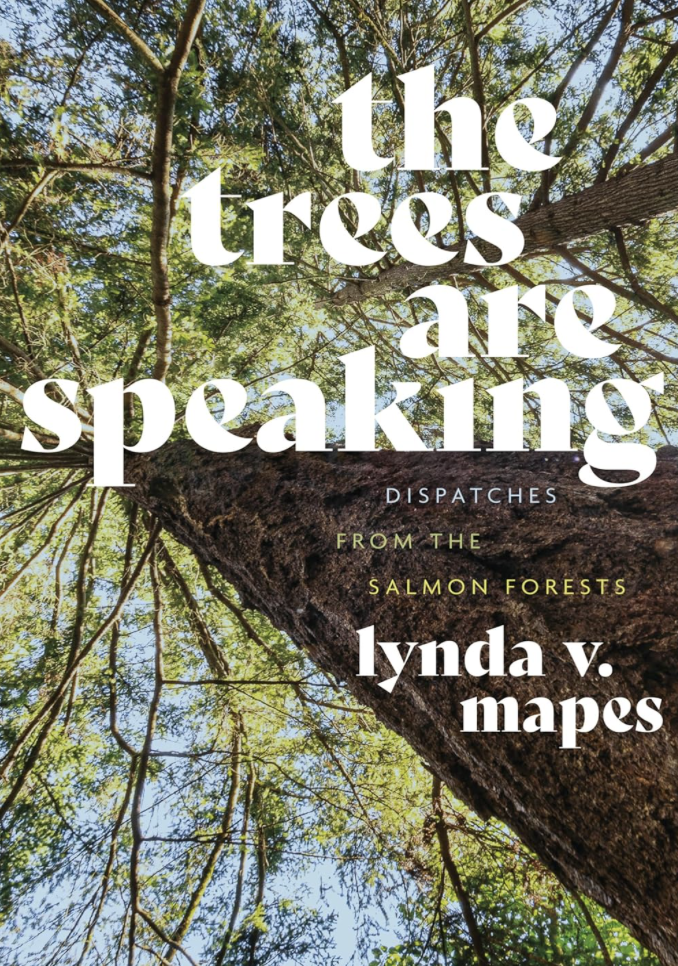
“The Trees Are Speaking: Dispatches from the Salmon Forest,” by Lynda Mapes, University of Washington Press, 2024.

Well, we all know that trees cannot talk. But we also know how important trees are. Just about everyone, no matter where they live, has admired a beautiful tree. It’s hard to imagine a landscape painting that doesn’t have at least one picturesque tree in it. We also know that trees give us wood for many uses, yield pulp for paper, and provide homes for wildlife. In addition, we’ve learned that trees can grow old and attain amazing height, can die from disease, can burn in forest fires – and more.

So when journalist Lynda Mapes entitled her book The Trees Are Speaking, she was using figurative vocabulary, filling 250 pages with good writing to educate us about these amazing living things that share the planet with us.

If you love nature, and especially if you are interested in environmental politics, this is a book for you.

The subtitle, “Dispatches from the Salmon Forest,” may seem a little strange, but we learn that there actually is a biological connection between the forest and the salmon that swim up fresh-water rivers (from both the Atlantic and Pacific oceans) to spawn and serve as food for wildlife.

Mapes is based in Seattle and recently retired from her reporter’s position at the Seattle Times, where her beat was both the environment and Native American affairs. She has won several awards, including the 2021 National Outdoor Book Award for Orca: Shared Water, Shared Home.

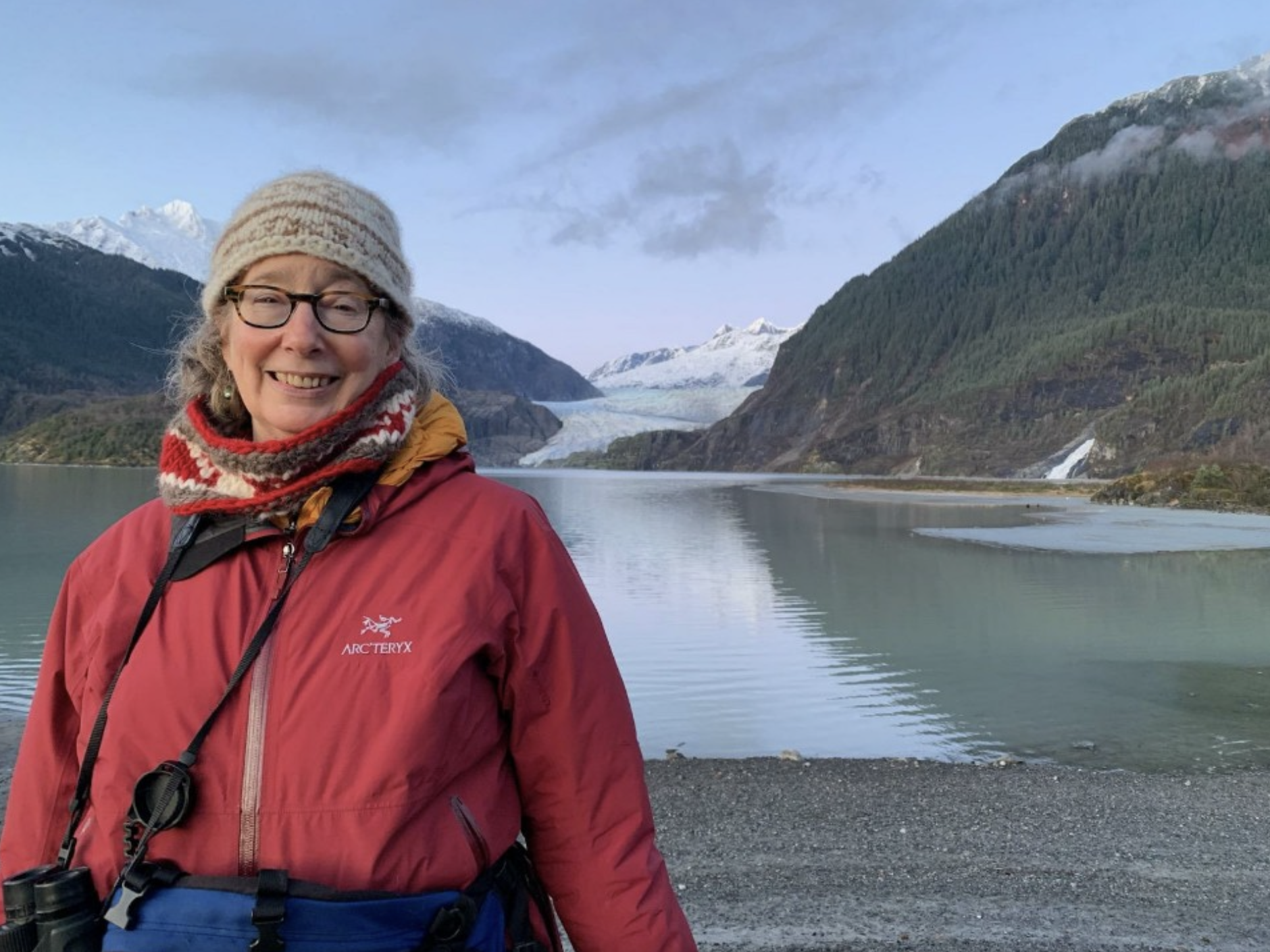
Author Lynda Mapes at the Mendenhall Glacier near Juneau, Alaska. Photo courtesy of Mary Catharine Martin.

She continues her work as an articulate, creative journalist sponsored by foundations and other media outlets, recently exploring the enormous Tongass National Forest in Alaska.

Full disclosure: I established a friendship with Mapes a few years ago when she came to the Harvest Forest in Petersham, Mass., near my home, where she got to know professional foresters and ecology academics and authored a book entitled “Witness Tree.”

To accomplish her goal of understanding the message the trees have for us humans, Mapes spent considerable time in the Pacific Northwest (primarily British Columbia, Canada) as well as in the northeastern state of Maine.

With narratives in both of these locations, she introduces the reader to experienced foresters and forest ecologists as well as to Native Americans, all of whom share their knowledge, hopes and dreams. One of the writers she quotes is Henry David Thoreau, whose book on the north woods of Maine was previously unfamiliar to me, even though I was aware of other works by Thoreau.

Mapes is not reserved in her approach to the people, the trees and the rivers. This might be called participatory journalism. She climbed one of the ancient Douglas fir trees, for example, just as she slept one night in the oak that was the subject of her earlier “Witness Tree” brook.

Mapes plays with language, adding to our enjoyment.

For example, she juggles and alters nouns and verbs and adjectives, using them in unexpected ways to help the reader experience what she experienced.

Here’s a sample:

“Over their lifetimes these grand old trees self-prune, dropping their branches from the bottom up, resulting in long, straight, branch free trunks towering to a short crown with a wind-blasted top. The bark, as the tree ages, becomes more than a foot thick and deeply grooved and takes on a dark, rich, reddish-brown color. Its twigs are densely quilled with needles and the cones, two to four inches long, are perfectly symmetrical. They make fine food for animals, including chipmunks, mice, shrews, red squirrels, and songbirds that poach seeds right out of the cone.”

 In the Pacific side, Mapes paid special attention to the Douglas fir, writing this:

“As a living tree, it is the anchor species of the moist forests westof the Cascades. So this was royalty that I was about to encounter,a Douglas fir soaring more than twenty stories. Armored with thickplates of bark, the Discovery Tree glowered with gravitas. It has stoodfor some four centuries. And here stood I, hoping not to show that Iwas nervous. No. It was way worse than that. I was hoping to survive this encounter that loomed large as this tree in my tiny, short little marshmallow-soft mammalian life.”

 I felt a sense of relief when Mapes’ climb up this big tree came to a safe ending, whereupon she wrote: “With a thump, my feet were back on the ground. I unclipped from the rope and harness, bewildered at the abrupt change of worlds. The tree’s motion stayed with me, the same way being at sea stays in the legs. I was still feeling the sky river of wind.”

While calling upon academic research as needed, there is playful delight at times, as in this paragraph:

“A calypso orchid lights the gloaming beneath a gnarled cedar, its magenta and white blossom a vision of tiny perfection, from its striped throat to the delicate pink spray of its bloom. This orchid’s common name isfairy slipper. If there are fairies here, I am pretty sure this is wherethey live, donning fairy slipper blossoms for midnight ballets amidqueen’s cup lilies and lady ferns on full-moon nights.”

 And her choice of words creates a mood and a sensation, as in this excerpt:

“It was a perfect August day, the sea wind tangy, the water green glass.Rocky islets were hatted with forests and porpoises knifed the water.Trees along the shoreline were sculpted to the blow of the wind. The mountaintops were quilled with old-growth trees, their silvered andbroken tops spearing the forest canopy and giving the land a porcupine back.”

The messaging in the book is mildly anti-capitalist as she describes how paper mills in Maine led to so much damage in the woods and, upon closing, caused havoc and despair in the mill towns. We learn about the infestation of insects, past and present, crossing oceans via international commerce. These are the bugs that killed and are still killing millions of trees – Dutch elm disease in the early 20th century and the emerald ash borer and wooly adelgid of today (killing ash and hemlock, respectively).

The reader rides a roller coaster of sadness and joy. In early chapters, the focus is on old growth forests – how much has been cut down, and the struggles to preserve those that remain. Later in the book, there is progress to celebrate, as society benefits from the awareness of climate change and the pride of both Native American tribes and  tree-hugging environmentalists.

[Allen Young has lived in rural North Central Massachusetts since 1973 and is an active member of several local environmental organizations. Young worked for Liberation News Service in Washington, D.C., and New York City, from 1967 to 1970. He has been an activist-writer in the New Left and gay liberation movements, including numerous items published at The Rag Blog. He is author or editor of 15 books, including his 2018 autobiography, Left, Gay & Green; A Writer’s Life.]

Posted in Rag Bloggers, RagBlog | Tagged , , , , , , | Leave a comment

THORNE DREYER / JOURNALISM / Central to the new Rag’s voice is to retain the levity of the original

By Thorne Dreyer / The Rag Blog / December 1, 2025

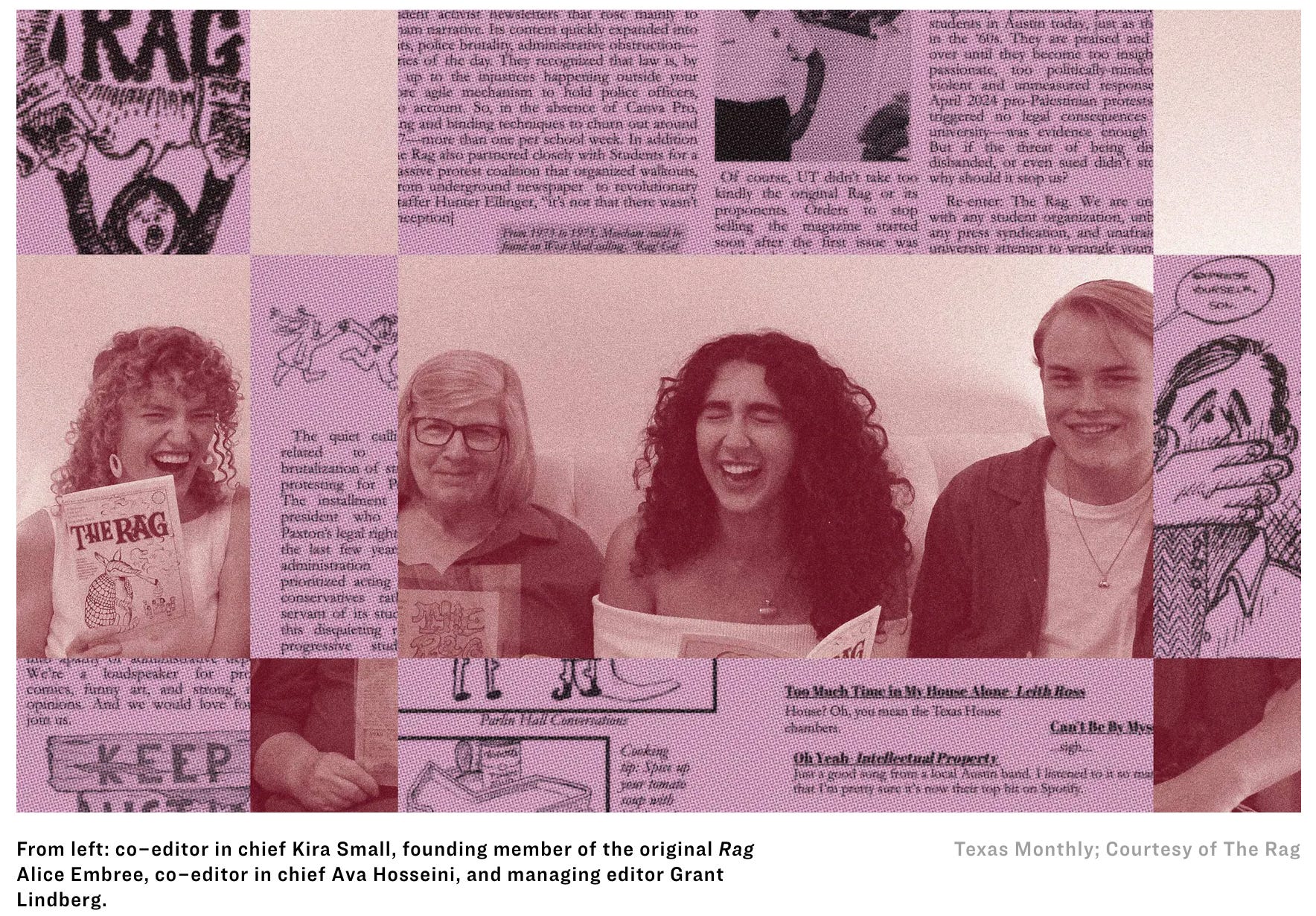
Since editors Ava Hosseini and Kira Small — with the help of managing editor Grant Lindberg — started their seemingly modest endeavor to resurrect the underground newspaper, The Rag, that we published from 1966 to 1977 in Austin — ancient history, to most of you — their new zine, also tagged “The Rag,” has taken off like few could have imagined. 

This week I’ve seen front page feature stories and meaty thought pieces about the importance of this new journalistic upstart. “Disillusioned UT seniors choose satire as a salve,” headlined the Austin American Statesman. With the subhead: “Pair revives 1960s publication forged in a similar fraught era.” “Counterculture magazine revived after nearly 50 years,” added The Daily Texan.

The head on an article in the San Antonio Express-News reads: “Disillusioned by UT, seniors choose humor over outrage — and revive 1960s-era newspaper.” “Why UT Students Are Reviving an Underground 1960s Newspaper,” headlined Texas Monthly in a substantive feature article — then, as a subhead, added, tongue firmly in cheek: “Instead of stalking our ex-boyfriends online, we started a newspaper.”

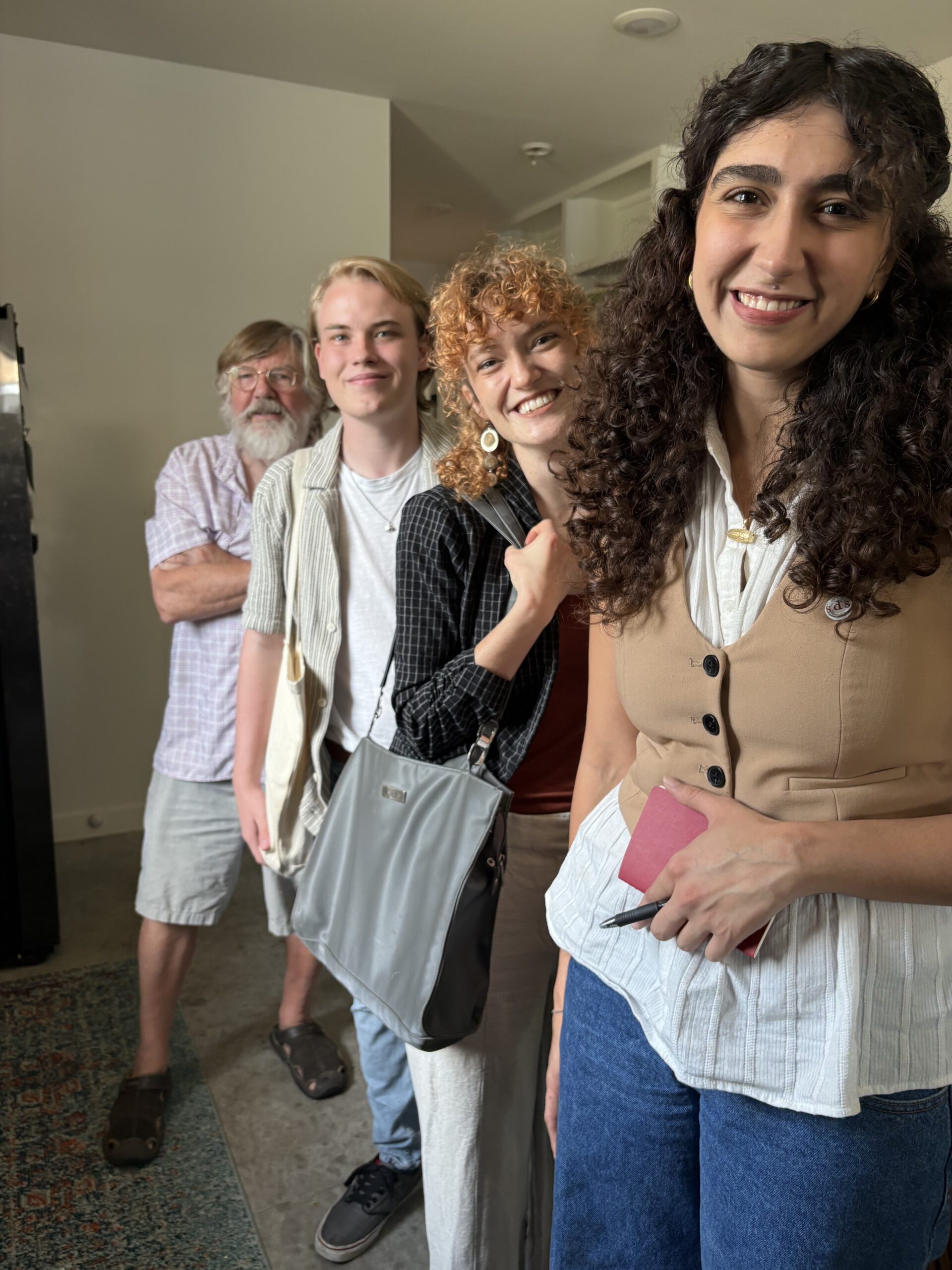
Some of The Rag’s founders, now nudging their 80s (don’t tell them I told you), offered encouragement and nuts and bolts advice, especially my colleague Alice Embree. We had a gathering of old and new at the editors’ home/office, which I attended. Alice was quoted in Texas Monthly, after watching Small speak to a group on the UT campus, “I was amazed at her courage to speak out, her energy.” Then she approached Small to offer help.

“Central to The Rag’s voice is its commitment to retaining the levity of the original — something that seems to come naturally to Hosseini and Small, “wrote Texas Monthly’s Sasha von Oldershausen. “Anger burns really quickly,” Small told her, “Humor is more sustainable.”

The San Antonio Express-Newsin a photo cutlinesaid that “The Rag co-editors-in-chief Kira Small and Ava Hosseini run the revived University of Texas underground magazine out of their apartment in Austin. Started in the 1960s to combat censorship on campus, the revived left-leaning magazine describes current events with humor, quality reporting and witty drawings.”

From left: The original Rag‘s Richard Croxdale, The Rag‘s managing editor Grant Lindberg, The Rag’s co-editors Kira Small and Ava Hosseini. Photo by Alice Embree / The Rag Blog.

Lily Kepner, who writes for Hearst papers the Austin American-StatesmanSan Antonio Express-News, and the Houston Chronicle wrote a feature piece that appeared in all three papers. In Kepner’s article, which covers the better part of two pages in the Statesman, she wrote: “The Rag — a countercultural, progressive magazine — first published Oct. 10, 1966 as part of a national underground syndicate of progressive magazines, seeking to counter the pro-Vietnam perspective. The inaugural issue, opposing the new conservative editor at The Daily Texan, combined advocacy, facts and humor in an attempt to rally the campus during an increasingly grave political moment.”

In 1972, Laurence Leamer, author of The Paper Revolutionaries, called the original Rag “one of the few legendary undergrounds” and historian John McMillian tagged The Rag a “spirited, quirky and humorous paper whose founders pushed the New Left’s political agenda even as they embraced the counterculture’s zeal for rock music, psychedelics, and personal liberation.” There would be hundreds of underground newspapers and Austin’s Rag, the first in the South, was among the most influential.

The Rag’s contemporary version could do worse than emulate such efforts in its own unique voice.

[Thorne Dreyer was the original editor of The Rag in 1966, soon joined by co-editor Carol Neiman. He has since edited the digital rebirth of The Rag —  The Rag Blog — and the Rag Radio show which he hosts and produces on KOOP-FM in Austin. His latest books are Making Waves, published by the Briscoe Center for American History, and Notes From the Underground, published by the New Journalism Project.]

Posted in Rag Bloggers, RagBlog | Tagged , , , , , , , , , , , | Leave a comment

SUSAN VAN HAITSMA / HISTORY / CodePink: Austin’s history is alive at the Austin History Center

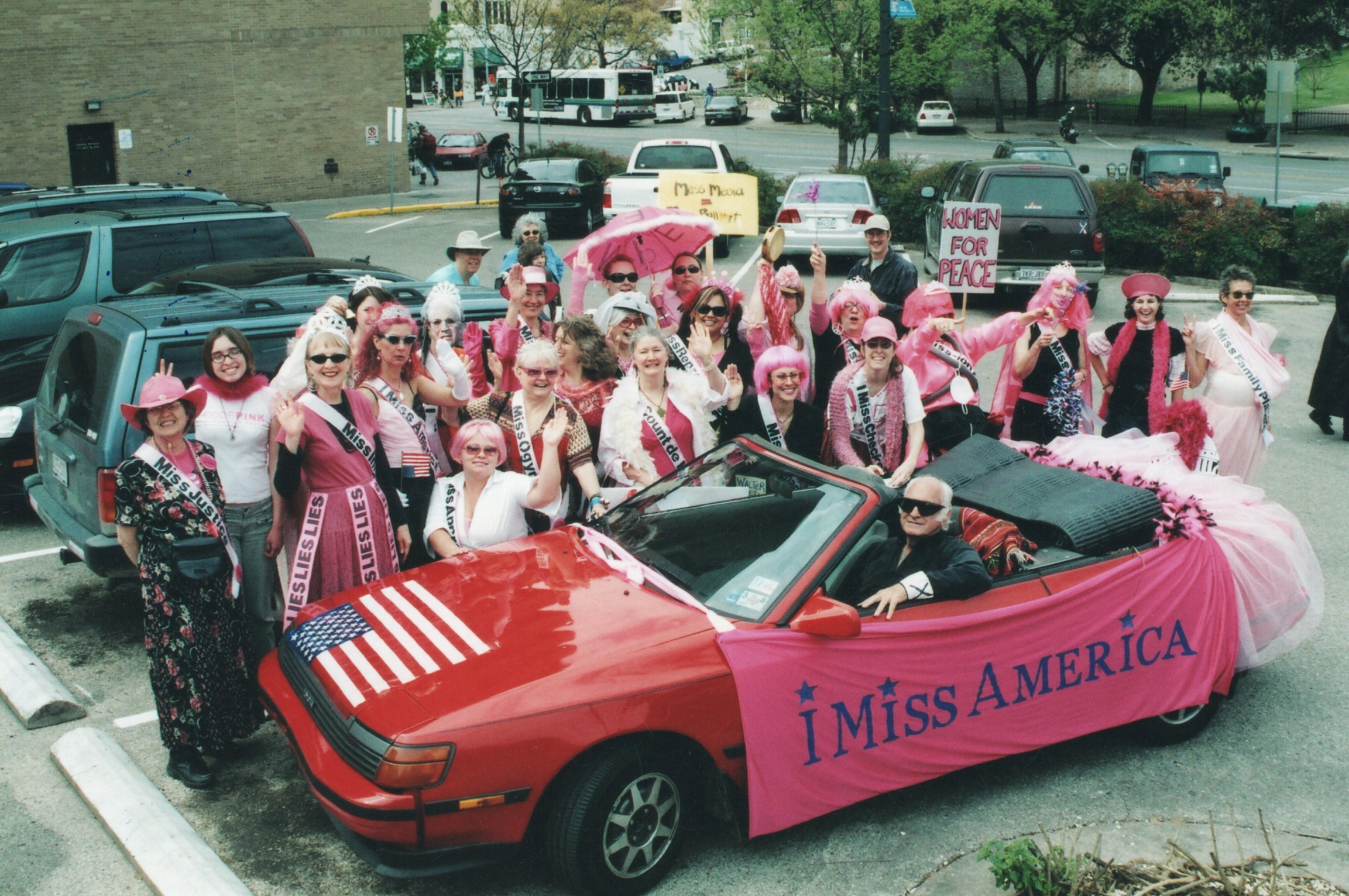
CodePink Austin at “I Miss America” pageant in Million Musicans March, March 17, 2007. Photo by Jim Turpin.

By Susan Van Haitsma / The Rag Blog / November 27, 2025

AUSTIN — With the current U.S. administration trying to excise and falsify U.S. history, we, the people who make history are more determined than ever to write, preserve, and make known our individual and collective experience as peace and social justice activists.  

I’ve been inspired by Rag Blog writers and publishers, Alice Embree and Thorne Dreyer, who have been carefully and persistently documenting through their writings and presentations the social justice movements they’ve been part of in Austin and beyond.  I was especially interested in Alice’s excellent memoir, “Voice Lessons,” since she is an Austin native and has been active in many intersecting movements here, including CodePink Austin, in which I also was involved.  

Her conscientious work in helping to establish and support the GI Rights Coffee House, Under the Hood (2009 – 2015) in Killeen was an important element of CodePink Austin’s activism.  Alice’s Substack writing continues to inspire me, and her archiving projects  — her own, The Rag’s, and now her late friend, Glenn Scott’s — have been part of the impetus to collect our CodePink Austin files into an archive.  

Alice’s archive is housed at the Briscoe Center for American History at UT, which has a Civil Rights and Political Activism section.  While considering that institution, I also thought about the Austin History Center (AHC) as a fitting archive for the CodePink Austin materials because I had seen an AHC display of local photographs called “Taking it to the Streets” at the Bullock Museum in 2020, shown in conjunction with the exhibit, “This Light of Ours: Activist Photographers of the Civil Rights Movement.”  

Because our CodePink Austin actions had been all about “taking it to the streets,” I contacted the AHC to describe what CodePink Austin had done in our years of activity (2004-2014), and the AHC Collections Manager responded with interest right away.

At the time, the AHC was beginning its move from the older, smaller building on Guadalupe Street into the larger, former Faulk Central Library right next door, and they could not accept physical archival materials until the move was complete.  That gave me time to get together the folks who had been most active with CodePink Austin to share the files we had saved about our antiwar actions during the Iraq and Afghanistan wars and compile the papers into a cohesive archive.  We met several times with the staff at the AHC, who were very helpful at every stage, and I am glad to report that the archive is now catalogued, partially digitized, and ready for anyone to research!

Most of the materials, such as fliers, meeting notes, news clippings, articles and physical photos taken before the use of digital cameras are organized in folders that one can only see by going to the AHC in person.  We also included artifacts, such as a “Pink Police” uniform, several banners, buttons, stickers, etc. as part of the physical archive. However, a number of PDFs and scanned photographs are available to see online as “born digital” descriptions of our CodePink actions, and one can see these by navigating the archive online.  For example, a descriptive PDF synopsis of CodePink Austin’s group history can be seen at this link: 

https://ahc.access.preservica.com/archive/sdb%3AdeliverableUnit%7Ce89ab6c4-a031-4a25-b78c-f7e1145c1b76/?view=render

International Womens Day March in San Antonio, March 2014, Jim Turpin, Marilyn White, Fran Clark, Heidi Turpin.

The Austin History Center held a well-attended open house for the public on September 7 as a “soft opening” of the Faulk Center space, and the reading room opened for limited hours, Thursdays through Saturdays from noon to five, with expanded hours expected soon.  I have been twice to the AHC since their reopening and have found it a welcoming, light-filled space. The first floor features displays of artifacts with plaques in English and Spanish explaining the archiving process.  The knowledgeable, friendly AHC staff in the reading room on the second floor help folks determine what they are looking for and retrieve the materials from the shelves of files in the upper floors.

For the past 20 years, the AHC has placed a special emphasis on Community Archiving, helping to preserve Austin’s Black, Latinx and Asian-American histories.  AHC staff have produced a number of excellent exhibits for our libraries and several outdoor venues helping to illuminate the local civil rights movements that have shaped Austin.  I am pleased that our Austin CodePink archive joins those collections. 

Every group and every movement for creative, nonviolent social change will develop their own methods of activism in response to the circumstances of their time.  Knowing what kinds of actions have been done in the past can inform and inspire in all kinds of ways.  Let’s keep these important People’s Histories alive.

Posted in Rag Bloggers, RagBlurb | Tagged , , , , , , , , , , | Leave a comment

MICHAEL MEEROPOL / COMMENTARY / Sleeping Giant: Thoughts on the results of the November 4 elections

Image from  Pix4Free.org.

By Michael Meeropol / The Rag Blog / November 18, 2025

The following is an expanded version of a commentary delivered over WAMC-FM on November 7, 2025, by Michael Meeropol, Professor Emeritus of Economics at Western New England University. It has been edited for The Rag Blog. Meeropol and Alice Embree will be featured on Thorne Dreyer’s Rag Radio program on KOOP 91.7-FM in Austin and streamed at KOOP.org, Friday, Nov. 21, at 2 p.m. to discuss this article and larger issues it raises.

I stayed up to watch the election results and was rewarded with evidence that the “sleeping giant” — the American people — had finally awakened to the danger that Trump and Trumpism poses to our society.   Yes, I saw the exit polls.  Most people claimed to be voting in favor of the candidate they voted for, not “against” anyone.  Yes, in two of the three major elections, the governorships of Virginia and New Jersey were won by so-called “moderates” — two “national security women.”   (Governor–elect Spanberger of Virginia served in the CIA before getting into politics.   Governor-elect Sherrill of New Jersey is a former Navy helicopter pilot who had graduated from the US Naval Academy.)

But I believe despite what voters told pollsters, there was an underlying goal for many of the people who came out to vote — and that was to “vote against Trump.”  The candidates running did not have to say it — the people answering pollsters did not want to say it.  But I believe that, for example, the people standing in line for hours in California to pass a ballot measure that they were very confident would pass without their votes — when there was no one on the ballot! — were there to make a statement against Trump and as one person told a reporter, voted “in defense of my freedom.” 

Meanwhile, the election of a Democratic socialist in New York City who brought out a hundred thousand young people who had never voted and probably wouldn’t have voted if he hadn’t been in the race has been considered an anomaly.  And this attempt to dismiss his victory as something totally impossible to replicate anywhere else has occurred despite the fact that he had to battle unbelievably strong headwinds. Once he won the primary, literally millions of dollars were spent by billionaires attempting to smear him as badly as any red baiters did in the McCarthy era.

The fact that Trump routinely called him a communist means almost nothing.  But the attempts to smear him as a radical Muslim – even hinting he would have celebrated 9-11 — did produce a fear in too many Jewish New Yorkers that the city would no longer be safe for them should he win. And this, of course, was despite the fact that he won the vote of young Jews.  Meanwhile, his campaign was focused like a laser on economic issues — which also had pride of place in the two gubernatorial campaigns.

And to return to the Virginia campaign, the Republican candidate for governor spent a tremendous amount of money running ads attacking trans kids in sports and bathrooms.  According to a Substack entitled Erin in the Morning [Check out “A Stunning Rebuke Of Anti-Trans Politics”—Dems Win Elections Nationwide Despite Anti-Trans Ads.]

“According to MSNBC, more than 57 percent of Republican ad spending in the Virginia governor’s race went toward anti-transgender messaging, an effort to revive what the party saw as a winning wedge issue in 2024. But a year later, with prices still high and anti-trans rhetoric solving none of voters’ real problems, the strategy appeared to backfire. Voters seemed tired of the culture wars and frustrated that Republicans remained fixated on scapegoating instead of governing.”

Both Democratic candidates for governor stressed economic issues in their campaigns — just as did Mamdani. Meanwhile, in Pennsylvania, three judges on the State Supreme Court were up for their 10-year “re-election” where the vote was Yes (keep them for another 10 years) or No (send them off the bench).  A very clever set of ads made it seem that voting “no” was a way of protecting the integrity of voting in Pennsylvania. In fact, knocking off these three judges would have created a right-wing majority which would have been ready to rule in favor of whatever ridiculous challenge Republicans would mount to steal the 2026 and/or 2028 elections. All three campaigns went down to ignominious defeat.

 And in California as I already mentioned, people waited in line for over an hour to vote for an idea, Proposition 50, which changed the State Constitution giving the Governor and State Legislature the power to increase the number of Democratic majority districts in California by five — matching exactly what the state of Texas did at Trump’s bidding — adding five Republican seats.

What does this mean? I saw one poll out of hundreds that tells it all.  Thirty percent of the population told pollsters they identified as MAGA — that is the Trumpified Republican Party — the people who waved signs at the Republican Convention calling for mass deportation — the people who have rushed to join the newly militarized ICE so they can snatch people with brown skin off the streets without warrants or accountability].

Guess what?  The same poll asked how many people identified with the No Kings protests.  That number was 43 percent.   Given that the No Kings movement has no national leadership — no nationally known face of the leadership — no agreed upon principles beyond defending American democracy against Donald Trump and his fascists and has gotten very slight coverage from lots of the national media — that number is remarkable.   

[For details see https://www.msnbc.com/rachel-maddow-show/maddowblog/poll-shows-no-kings-protest-movement-topping-maga-public-support-rcna241803

It is particularly remarkable because the Speaker of the House was all over national television calling the No Kings rallies “hate America” events and attacking the participants as Hamas supporters, terrorists, supporters of political violence and communists. (Not sure I got all his epithets but people can look it up!). The attack lines of Trump and his Trumpists did not work for that 43 percent and I consider that remarkable as well.

I am convinced that the reason the elections were blowouts is because the energy generated by the giant crowds at the No Kings Day protests carried over to election day. So many people at these rallies asked each other and the speakers what can we do? It is easy to give money. It is (relatively) easy to write a letter to an editor. It is harder to take a drive and stand in a crowd for a few hours with a sign. It is much harder to knock on doors for your preferred candidate. Yet thousands of people — in New York thousands of young people — did just that for the New York Mayoral candidate who Trump called a communist as well as for the two Democrats in Virginia and New Jersey.  And in California, people waited in line for over an hour for an idea — proposition 50 — in California.

America is back.  But — now is not the time to rest on our laurels.  These blowout elections are validation of all the work that’s been done exposing the atrocities of the Trump Administration and making sure at least the majority of the public sees through the administration’s lies.  But it is almost a full year to the 2026 midterms.  A lot can happen in that time.  It is essential that the people keep coming out to demonstrations and rallying around support for our immigrant neighbors targeted by ICE.

More importantly, lawyers, officials, etc., have to prepare to fight Trump’s and the Republicans’ attempts to steal the 2026 election.  We know they are planning to do that — only massive voter turnouts and massive vote margins will stop them — as will courts like the Pennsylvania Supreme Court.   

The people have demonstrated they understand the threats to our democracy posed by Trump and his enablers — we just have to keep it up for at least the next year.

Posted in Rag Bloggers, RagBlog | Tagged , , , , , , , , | Leave a comment

LAMAR HANKINS / COMMENTARY / Norman Finkelstein explains the Israel-Gaza conflict

Norman Finkelstein. Image from The DePaulia / Flickr.

By Lamar Hankins / The Rag Blog / November 13, 2025

Norman Finkelstein was born in New York City in 1953, a son of Jewish parents who survived the Holocaust. His mother grew up in Warsaw and survived the Warsaw Ghetto and the Majdanek concentration camp. And his father was a survivor of both the Warsaw Ghetto and Auschwitz. They met in a displaced person’s camp in Austria after the war and emigrated to the United States. 

Finkelstein received his PhD in 1987 from Princeton University as a political scientist specializing in the Israeli-Palestinian conflict. In 2020, he was named the fifth most influential political scientist in the world.  He has written 13 books based on his scholarship, and has been viciously attacked for that scholarly work by apologists for the actions of the Israeli government.  Finkelstein argues that “the real issue is Israel’s human rights record.”

Recently, Finkelstein has given several public lectures and interviews in which he offered the facts about the Israeli-Gaza conflict from his scholarly perspective.  This article attempts to encapsulate his views, mostly using his actual spoken words, with minor editing to avoid repetition and enhance readability. I quote parts of an an AI-generated transcript of Finkelstein’s lectures and interviews.

“Do you condemn what Hamas did on October 7th?”

The British television personality and sometime friend of Donald Trump, Piers Morgan likes to begin any recent discussion of the Israeli-Palestinian conflict with the question, “Do you condemn what Hamas did on October 7th?”  For Finkelstein, this is a complex question “not to be answered glibly.”  

“[E]vents in Gaza did not begin on October 7th. There is a long, let’s call it a prehistory.  I think a logical place to begin is 1948 when Gaza becomes a distinct entity. About 300,000 Palestinians were expelled [to Gaza] from Israel.  Altogether, 750,000 Palestinians were expelled. But 300,000 of those 750,000 ended up in Gaza.  And that I think is the point of departure of any rational understanding of the situation there, namely 80% of the people in Gaza from October 7th forward, 80% of them, are refugees or descendants of refugees.  It’s overwhelmingly a refugee population.  It’s also, [by] fully half, a child population under 18 years of age.”

The Gaza concentration camp

“In the early 1950s, when Gaza was under Egyptian administration, outside observers came to Gaza, some just to see the situation, others to work there. The image that constantly recurs, [such as from] E. L. M. Burns [a Canadian], who was the senior UN official in Gaza, describes Gaza as a huge concentration camp. Bear in mind, I’m talking from the very beginning, the 1950s.  Under Egyptian rule, Gaza is already being described as a huge concentration camp.”

“Most of the people in this room will remember Senator Al Gore, who ran for president in the year 2000.  His father, Albert Gore, Sr. had also been a senator.  In July 1967, right after the June 1967 war, when Gaza comes under Israeli rule, Senator Albert Gore, Sr., goes to Gaza. He then comes to speak before the Congress on what he saw.  He said Gaza is a huge concentration camp on the sand.”

“If you fast forward to 2002, a senior Israeli sociologist at the Hebrew University in Jerusalem, Baruch Kimmerling, writes a little book. In passing, he discusses Gaza.  How does he describe Gaza?– ‘The biggest concentration camp ever to exist.'” 

“[In] 2004, the head of Israel’s National Security Council, [who is] still active in government or in official capacities, Giora Eiland, [has] a conversation with an American official [and] describes Gaza: ‘It’s a huge concentration camp.’  That’s coming from the head of Israel’s National Security Council.” 

Hamas — 2006

“Now bear in mind, 2004, when [Eiland] makes that observation, that’s before Israel imposes the brutal medieval blockade on Gaza, which begins in January 2006.”

Finkelstein explains that in January 2006, the president of the United States was George W. Bush, who began what he called “democracy promotion.”  Bush demanded that Palestinians hold elections, but at that time “Hamas did not want to participate because it felt that the elections were part of a fake process begun in Oslo in 1993, what came to be called the Oslo process, [which began] in September 1993 when Yasser Arafat, Yitzhak Rabin, and Bill Clinton began the process that was supposed to end the conflict. It didn’t, but we’ll leave that aside. In any event, Hamas didn’t want to participate because they felt it was part of a charade or farce.  But pressure was put on them to participate. They did.  They didn’t expect to win, but they did. They won on a platform, not on ideology, not on trying to destroy the state of Israel. That was not their platform. They ran on a platform of reform.”

Continue reading
Posted in Rag Bloggers, RagBlog | Tagged , , , , , , , | Leave a comment

ALICE EMBREE / MEDIA / A new Rag for a new generation

The Rag, October 10, 1966 and September, 2025.

By Alice Embree / The Rag Blog / November 6, 2025

Many of us have worked to keep The Rag flag flying since the 2005 reunion.  It’s hard to believe that was 20 years ago.  We’ve kept Rag history alive with The Rag Blog, Rag Radio, and a 2016 celebratory fiftieth reunion that featured a film and a book, Celebrating The Rag: Austin’s Iconic Underground Newspaper.  We’ve also been invited to University of Texas classroom presentations.  

It’s great to see a new generation, inspired by the elder Rag, decide to publish a contemporary version.

Some of the Old Guard, met with the creators of a new Rag on August 23, at the home of Richard Croxdale. When Kira Small mentioned that she was majoring in pre-law and theater, and one of the OG Ragsters said, “It’s good to have theater to fall back on.”

The gathering reminded me of what is wonderful about the Rag community of yore.  The quick wits were alive and well despite the prevalence of hearing aids and canes.  The three University of Texas students had all the audacious energy that gave birth to the first Rag.  How could we not embrace their enthusiasm?

Soon, the first issue made its debut in the campus corridors as a zine.

Although the original Rag grew up to tabloid size, it started small. The first 12 issues were on folded newsprint, about the same size as the contemporary version. What makes the new zine version newsworthy is that it so perfectly meets the moment when free speech is on the line at the University of Texas at Austin. And it does so with irreverent humor just like its predecessor. In an age overwhelmed by social media and driven by for-profit algorithms, it is charmingly analog.

Kira Small wrote under this headline in the first issue of the new Rag: “No, Social Media is NOT the New Public Square.”

Trump’s alliance with tech bros is about more than homoerotic Twitter fights and impressing Papa Peter Thiel. It’s about sweeping debate off the streets and onto social media. You can scream as loud as you want, so long as it’s into a void.

The new Rag’s humor and cartoons are reminiscent of its predecessor.  A cartoon in the November 2025 issue is titled, “Governor Abbott coming soon to a bathroom near you.” A student is pulling Abbott and his wheelchair down the hall while the governor holds a hall pass and a Texas flag. If a photo is worth a thousand words, cartoons may be word millionaires.

I think the new Rag is meeting the moment with a zine that is provocative. And what it provokes is conversation and laughter.  Not more screen time.

I’m sure the new Rag caught the attention of the university “powers that be,” but it garnered some great press as well.

Sasha von Olderhausen at Texas Monthly, wrote Why UT Students Are Reviving an Underground 1960s Newspaper,” in the October 14, 2025, issue.

For more on the reincarnated Rag, read the October 15th Daily Texan article by Jack Polishook.

The new Ragstaffers say,

In the few days since we began distributing the first issue of the Rag’s revival, we’ve been totally overwhelmed by the support pouring in from around and beyond Austin… Our team is a small, self-funded band of undergrads, and we’re working hard to produce the magazine at the rate of its reception.

You can help. Learn how:

https://substack.com/@txragmag

[Alice Embree, an Austin writer and activist, is the author of Voice Lessons, published in 2021.  She is an editor of Celebrating The Rag, published in 2016 and Exploring Space City!, published in 2021.  She posts on Substack as well as The Rag Blog.]

Posted in RagBlog | Tagged , , , , | 2 Comments

JOSHUA BROWN / LIFE DURING WARTIME SPECIAL / Remembering Dick Cheney

Previous installments are archived at
http://www.joshbrownnyc.com/ldw.htm

Posted in Rag Bloggers, RagBlog | Tagged , , , , , , | Leave a comment

ALICE EMBREE / BOOK REVIEW / Insurgent Politics in the Lone Star State: Remembering the Antiwar Movement in Austin, Texas, 1967-1973

By Alice Embree / The Rag Blog / September 29, 2025

This review is a cross post from Alice Embree’s Substack.

Rag Radio with guest Martin Murray:

Alice Embree was cohost with Thorne Dreyer on Rag Radio interviewing author Martin Murray on KOOP 91.7 FM in Austin. Listen to the interview.

Austin Book Events featuring author Martin Murray:

4:00 p.m., Tuesday, October 7  / Briscoe Center for American History / Sid Richardson Hall, Unit 2 / 2300 Red River Street, Austin, TX 78712 / Doors open at 4:00 p.m.

1:00 p.m., Thursday, October 9  / Batch Craft Beer and Kolaches / 3220 Manor Road, Austin, TX 78723

Martin Murray’s Insurgent Politics in the Lone Star State provides an insider’s view of Austin’s antiwar movement between 1967 and 1973, exploring that period in depth through his own personal narrative, scholarly research, and a focus on surveillance.

Martin’s own story begins in California where he graduated from the University of San Francisco and decided to file as a conscientious objector rather than be drafted into the war. He arrived in Austin in the fall of 1967 as a graduate student.

His personal journey unfolds with a sense of urgency and unknown outcomes. As the Vietnam War escalates, the protests evolve and tactics change. Martin lets us view this from a participant’s vantage point – the moral outrage as the death toll mounts, the debates as the movement shifts from protest to direct action and disruption, and the organizing taking place on many fronts.

Martin also brings a scholar’s eye to the story, documenting pivotal events in Austin with well-researched detail. He covers the 1968 Don Weedon Conoco demonstrations, and devotes forty pages to two events in 1969 – the Waller Creek tree protest and the Chuck Wagon riot. No writer has covered this period with such detail. Researchers will appreciate his timeline and endnotes for years to come.

Martin writes that “The Austin SDS chapter operated on a model of persuasion and consensus, tapping into the deep roots of Texas irreverent populist traditions.”  Martin describes the unique character of the Texas movement and the cast of characters. At a protest of Marine recruiters, he remembers Dick Reavis responding to a heckler who tells him to “Go back to Russia.”

“Dick, who was holding his Coke bottle by the top of the long neck (as he always did), slowly spilled out his words in a distinctive southern drawl: ‘No, I don’t think so. I’m kind of partial to China myself.’” [p. 61]

Martin’s book adds to the Texas lore, something I always appreciate.

In one lengthy sentence, Martin provides this synopsis,

“The thread running through seemingly disconnected events – perhaps starting with the March 1969 SDS National Council meeting in Austin, followed by the 1969 Chuck Wagon uprising, the anti-ROTC demonstrations (spring 1970), the May 1970 mass mobilization after the invasion of Cambodia and the Kent State killings, the Armadillo May Day Tribe and the May Days demonstrations in Washington, DC, (May 1971), the protests at the LBJ Library dedication, and the mass students strike in spring of 1972 — was increasingly heightened security presence.” [pp. 34-35]

The author’s expedition through surveillance was motivated, in part, by a desire to research his own life. What he found instead was a “Historical Doppelganger,” a ghostly representation of his life where he was frequently confused with his twin brother.

Martin’s focus on surveillance is thorough. He has the passion of a sleuth, tracking down material from the FBI through the Freedom of Information Act, and delving into sources at the University of Texas Briscoe Center for American History. He pored over the archived papers of Lt. Burt Gerding, the Austin Police Department’s head of Criminal Intelligence, Allen Hamilton, chief of the University of Texas campus police, and George Carlson, head of security for the University of Texas System.

Martin accessed thousands of pages from FBI reports. He shared some of those as he was finalizing his manuscript. I was surprised to read a lengthy description of Arkansas communes, many of them familiar to me. Martin uncovered some gems at the Briscoe as well, including a taped interview with Burt Gerding conducted by Briscoe archivist Sara Clark. Lt. Burt Gerding was in a class by himself — both blowhard and provocateur. He often bragged about the havoc he was able to create. Martin followed up with several targets of the havoc. They contradicted Gerding’s “intelligence.”

Lt. Burt Gerding in the suit. Photo by Alan Pogue.

What did the various agencies find out about activists through their surveillance, photographs, and network of informants? Martin argues that those who spied were hobbled by their own biases, always looking for an organization or affiliation to explain the scale of the insurgency. The surveillance apparatus missed the point. The antiwar movement was reacting to an escalating War in Vietnam, to the draft required to feed that war effort, to atrocities like My Lai, and to the official lies used to justify the war.

“The security agencies could not break from their underlying premise that the Austin movement was a creature not of its own making but an entity put in motion by some secret puppet master orchestrating our every move.” [p. 30]

I was eager to see this book make it into print. It describes the history that was adjacent to my own. I was involved in the early years of Students for a Democratic Society (SDS) at the University of Texas at Austin. I left Austin in the summer of 1967, following a major free speech battle in which I was a central figure. Martin arrived in the fall. I missed a lot of the period Martin describes.

Martin was part of a later incarnation of Austin SDS. He documents the vibrant antiwar activity that took place with SDS leadership and continued even as SDS splintered apart in 1969. That is an important contribution for historians — a unique take on the continuity of antiwar activism.

Insurgent Politics in the Lone Star State is a great addition to the history of antiwar activism. What happened in the Lone Star State didn’t always get attention from the national press. Martin’s book is a timely read in an era that once again requires insurgent politics and faces new forms of surveillance.

Posted in RagBlog | Tagged , , , , , , | 1 Comment